 PROJECT 243
Commerce / IntegrationsDeployed
The Suspension Source
A delivered Magento storefront that remains in use under another developer’s care.
A retail operating system that connects checkout, trade-ins, inventory, customer loyalty, and online commerce across store workflows.
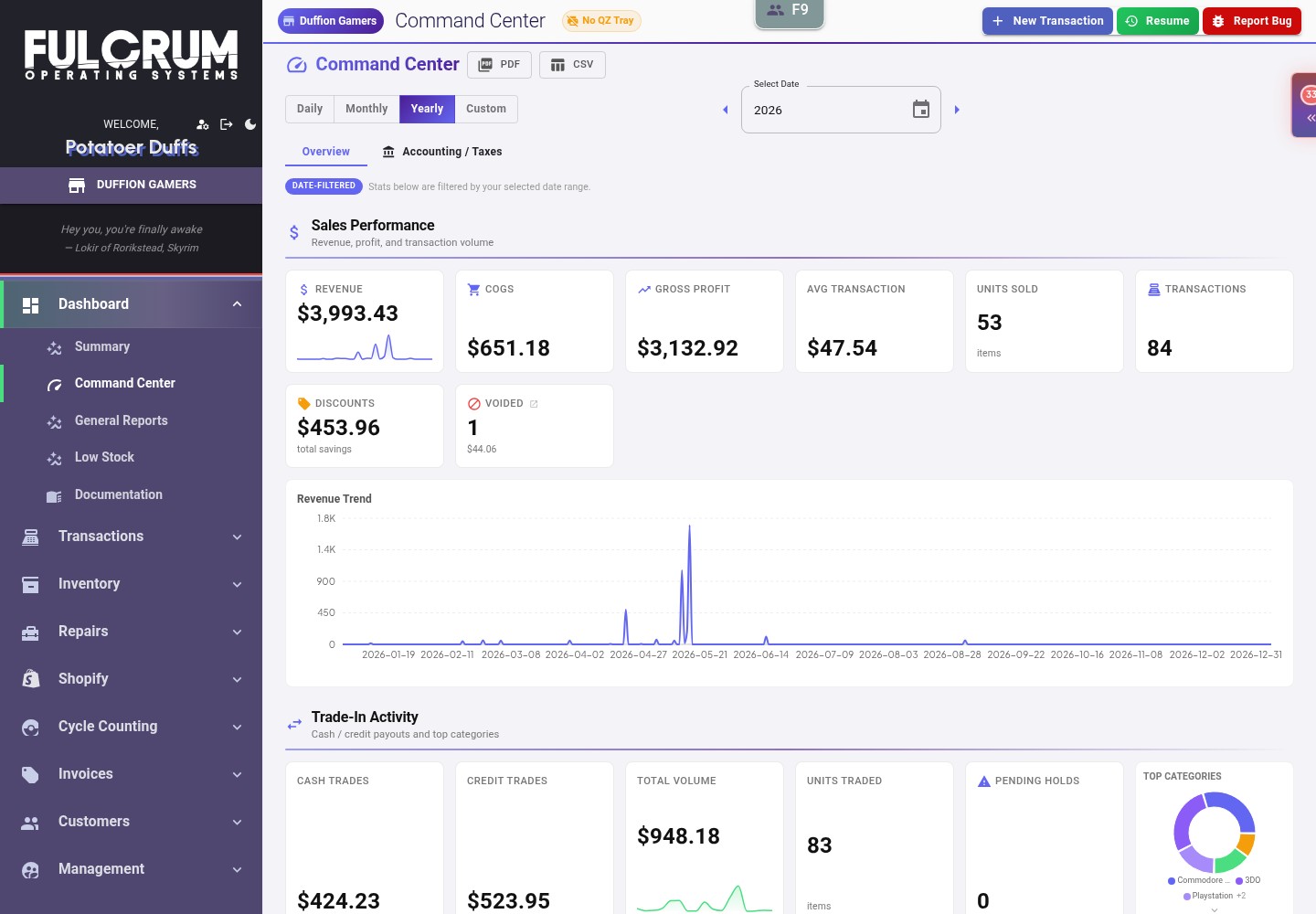
A card-and-game store needed a point-of-sale that could handle complex inventory (card games, sets, singles, trade-ins), Shopify sync, payments, and SMS, plus a marketing site to front it. Off-the-shelf POS couldn't do trade-in flows or 3D-friendly cataloging.
A Next.js and TypeScript retail application backed by MongoDB, with a separate synchronization service for commerce and catalog work. The implementation covers the full retail lifecycle, from intake and reservations through payment, returns, reconciliation, and reporting.
FULCRUM retail software connects the counter, inventory and online commerce for card-and-game stores. This case explains the operating workflows and the recovery rules behind them.
FULCRUM grew around the operating needs of card-and-game retail: ordinary sales sit alongside trade-ins, singles, preorders, repairs, store credit, and online inventory. Treating each of those as a disconnected add-on would leave staff reconciling the gaps at the counter.
The application brings those activities into a shared retail workflow. Checkout connects customer activity and payment with inventory changes; intake and reservations handle stock before it becomes part of a completed sale. Command Center reporting gives operators a separate view of sales, drawers, and inventory health.
MongoDB transactions coordinate checkout writes, and scoped reservations protect quantities already allocated to another transaction. Payment handling includes split captures, refunds, and recovery for interrupted checkouts. These are explicit parts of the implementation because a partially completed retail operation needs a recoverable state.
Loyalty and store credit follow the transaction boundary as well. A customer’s kiosk selection is not treated as the completed financial action; finalization owns the transition that affects the sale.
A companion synchronization service handles Shopify product, inventory, and order workflows, including retry and repair paths. Background catalog work uses bounded jobs, leases, and release controls so enrichment can yield to higher-priority commerce work.
The result is a system spanning the counter and the online store, with recovery and reporting built into the operating model. The screenshots show the transaction experience and the populated Command Center rather than a generic dashboard mockup.
Related engineering: MongoDB transactions and reporting, TypeScript applications, and Shopify integration.
A useful retail brief includes interrupted sales as well as successful ones. Identify which system owns stock and how staff should handle a payment or synchronization result that needs review.
For a related project, see retail integration development.
PROJECT 243A delivered Magento storefront that remains in use under another developer’s care.
 PROJECT 245
A delivered Magento commerce project still in place under a different developer.
 PROJECT 224
A running integration that moves transportation orders from SQL Server into a shipment-processing workflow, with an operator view of progress and logs.
This is the kind of build I take on. Book a call and we'll scope yours.